
No, not in the way people usually mean it. Ibogaine carries a real, documented risk of fatal cardiac arrhythmia. It is not a drug where the danger is theoretical or limited to careless use.
That risk can be reduced substantially by proper medical screening, correcting electrolytes, clearing interacting drugs, and continuous cardiac monitoring for days rather than hours. It cannot be reduced to zero. Anyone who tells you otherwise is selling something.
The honest framing is not "is ibogaine safe" but "how much risk am I taking, what changes it, and is that trade worth it for my situation." A person facing a fentanyl addiction with a real chance of dying this year is doing a different calculation than someone curious about a psychedelic experience. Both deserve the actual numbers.
How dangerous is ibogaine, really?
That is exactly what I wanted to know when we started research for our documentary about ibogaine. Unfortunately, there is no central registry of ibogaine treatments or deaths, so any precise-sounding statistic should be treated with suspicion. What exists is a set of case reviews.
The most cited is a 2012 review in the Journal of Forensic Sciences, which examined 19 deaths occurring between 1990 and 2008 within 76 hours of taking ibogaine.1 None were attributed to the drug's direct neurotoxicity. The pattern that emerged instead was pre-existing cardiovascular disease, concurrent use of other drugs (opioids in particular), and in several cases the absence of any medical supervision at all.
Estimates of a per-treatment fatality rate circulate widely, often in the range of one death per few hundred exposures. Treat these as rough. Both halves of that fraction are unreliable: deaths outside medical systems go unreported, and nobody knows how many treatments actually happen. The useful conclusion is not a number. It is that ibogaine's risk sits in a completely different category from psilocybin or MDMA, and closer to a procedure that requires an anesthesiologist.
The deaths cluster around identifiable, screenable causes: undiagnosed heart conditions, depleted potassium and magnesium, interacting medications, and opioid use around the treatment window. That is genuinely encouraging, because it means most of this risk is addressable. It also means a provider who does not screen for those things is exposing you to nearly all of it.
Why ibogaine is hard on the heart
Ibogaine blocks the hERG potassium channel, which carries the current your heart muscle uses to reset electrically after each beat.2 Slow that reset and the recovery phase lengthens, which is visible on an ECG as a prolonged QT interval.
A prolonged QT is not itself an emergency. The problem is what it makes possible. Past a certain point, the heart becomes vulnerable to torsades de pointes, a ventricular arrhythmia that sometimes resolves on its own and sometimes degenerates into ventricular fibrillation and cardiac arrest. This is the mechanism behind essentially every ibogaine death that isn't an opioid overdose.
Two features make this harder to manage than it sounds. Ibogaine is metabolized into noribogaine, which also blocks hERG and clears from the body slowly. And the doses used for opioid detoxification are far higher than those used in ceremonial or "microdose" contexts. The risk is dose-dependent, and detox doses sit at the top of the range.
The risk window is longer than the experience
This is the part that gets people hurt, because it runs against intuition.
The acute psychoactive phase lasts somewhere between four and eight hours, followed by a long, exhausting comedown. But because noribogaine persists, QT prolongation has been observed to continue for days after dosing.3 Someone can feel physically fine, walk without help, hold a conversation, and still be carrying a measurably elevated arrhythmia risk.
Providers who cut monitoring short at the point the person "seems okay" are ending it during a period when the risk is still real. A serious clinic keeps continuous cardiac monitoring going for several days, and repeats ECGs before discharge rather than at the point of subjective recovery.
Who is most at risk
Risk is not evenly distributed. These are the factors that move it most, and every one of them is detectable before treatment begins.
| Factor | Risk | Why it matters |
|---|---|---|
| Structural heart disease or prior arrhythmia | High | A heart already prone to rhythm disturbance has far less margin when the QT lengthens. Often undiagnosed until an ECG or echocardiogram finds it. |
| Congenital long QT syndrome | High | Starts the QT interval closer to the danger threshold. Frequently silent until a triggering drug is introduced. |
| Low potassium or magnesium | High | Both electrolytes lengthen the QT when depleted, and both are commonly low in people who have been vomiting, in withdrawal, or eating poorly. Correctable in days. |
| Methadone | High | Prolongs the QT independently and has a long half-life, so it is still present well after the last dose. Requires supervised transition to a short-acting opioid and an extended clearance period. |
| Other QT-prolonging medications | High | Some antidepressants, antipsychotics, antibiotics and antiemetics stack with ibogaine's effect. This is why a full medication review, including anything over the counter, is not a formality. |
| Opioid use during or after treatment | High | Ibogaine strips opioid tolerance. A dose that was routine before treatment can be fatal a week later. Several documented deaths are overdoses, not arrhythmias. |
| Liver impairment | Moderate | Ibogaine is cleared hepatically, largely via CYP2D6. Impaired clearance raises and prolongs exposure. Common in people with long substance-use histories. |
| Dehydration | Moderate | Vomiting is common during treatment and drives electrolytes down further, which is why IV access and repeat bloodwork matter throughout, not just beforehand. |
What proper screening actually looks like
Use this as a checklist when you evaluate a provider. If they cannot describe most of it without hedging, that tells you what you need to know.
- A 12-lead ECG before treatment, with the QTc calculated, not "we check your pulse."
- An echocardiogram where history, age or ECG findings warrant it.
- Full bloodwork, including potassium, magnesium, liver function and kidney function, with time built in to correct what comes back abnormal.
- A complete medication and substance review, covering prescriptions, supplements and anything taken recreationally.
- A supervised taper off methadone or buprenorphine onto a short-acting opioid, weeks in advance where needed.
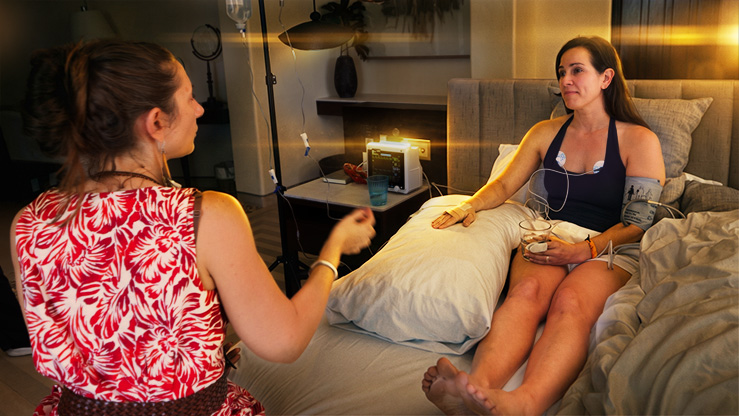
- Continuous cardiac telemetry during dosing and for days afterward, watched by someone trained to read it.
- IV access maintained throughout, for fluids, electrolytes and emergency drugs.
- A defibrillator on site, and staff currently certified in advanced cardiac life support.
- A physician physically present. Not on call, not reachable by phone, not in the next town.
- A written plan for hospital transfer, with a known distance and a known receiving facility.
One thing that is not a useful signal: the country. Some of the most medically rigorous ibogaine providers in the world operate where the drug is unregulated, and some of the most reckless operate in the same places. How to vet a provider properly goes through the questions that actually separate them.
The danger after you go home
The risk does not end at discharge, and the second peak catches people who thought the hard part was over.
Ibogaine substantially reduces opioid tolerance. Someone who returns to their previous dose after treatment is taking an amount their body can no longer handle, and a meaningful share of post-ibogaine deaths are overdoses in exactly this window. They are not arrhythmias, and they do not happen during treatment at all.
This is one of the strongest arguments for treating integration as part of the medical picture rather than an optional extra. The people who do best are the ones who leave with structured support already in place, not the ones who leave feeling reborn and improvise from there.
What actually reduces the risk
Research is moving in a genuinely useful direction. A 2024 study in Nature Medicine of magnesium-supported ibogaine treatment in special operations veterans with traumatic brain injury reported no serious cardiac events across the cohort, with magnesium administered specifically to counter QT prolongation.4 A separate open-label safety study in the Netherlands took a similarly controlled hospital approach to opioid detoxification.5
Neither makes ibogaine safe in an absolute sense. Both point the same way: this drug's risk is substantially a function of screening, electrolytes, dose and monitoring, which are the parts a competent medical team controls. The difference between a well-run clinical protocol and a ceremony in a rented house is not atmosphere. It is survival odds.
Key takeaways
- The mechanism is cardiac. Ibogaine blocks hERG, prolongs the QT interval, and can trigger a fatal arrhythmia.
- The risk window outlasts the experience by days, because noribogaine clears slowly.
- Most documented deaths are screenable: heart disease, low electrolytes, interacting drugs, opioid use around treatment.
- Methadone is the single highest-risk combination. It needs weeks of planning, not a few days.
- Losing opioid tolerance is its own danger. A pre-treatment dose can be fatal afterward.
- The provider's protocol is the biggest variable you control. Screening, telemetry, a defibrillator, and a physician in the room.
Frequently asked questions
How many people have died from ibogaine?
There is no central registry, so no exact figure exists. The 2012 Journal of Forensic Sciences review examined 19 deaths between 1990 and 2008 occurring within 76 hours of ingestion. Because treatment happens largely outside regulated medical systems, the true count is likely higher than what has been published.
Can ibogaine cause a heart attack?
Not a heart attack in the usual sense. The danger is an arrhythmia. Ibogaine and noribogaine block the hERG potassium channel, lengthening the heart's electrical recovery time. A sufficiently prolonged QT interval can trigger torsades de pointes, which can become cardiac arrest.
How long does the cardiac risk last?
Longer than the psychoactive experience. Noribogaine has a long half-life and QT prolongation persists for days. Reputable providers keep patients monitored well past the point where they feel normal, which is exactly when the temptation to send someone home is highest.
Is ibogaine safe if I'm on methadone?
Methadone is one of the highest-risk combinations. It prolongs the QT interval on its own and has a long half-life, so it lingers well after the last dose. Legitimate providers require a supervised transition to a short-acting opioid and an extended clearance period, which can take weeks.
Does a clinic being in Mexico or Costa Rica make it unsafe?
Location is not the variable that matters. What matters is cardiac screening, continuous monitoring, resuscitation equipment, and whether a physician trained in advanced cardiac life support is physically present.
Sources
- Alper KR, Stajić M, Gill JR. "Fatalities temporally associated with the ingestion of ibogaine." Journal of Forensic Sciences, 2012;57(2):398–412.
- Koenig X, Hilber K. "The anti-addiction drug ibogaine and the heart: a delicate relation." Molecules, 2015;20(2):2208–2228.
- Glue P, Lockhart M, Lam F, et al. "Ascending-dose study of noribogaine in healthy volunteers: pharmacokinetics, pharmacodynamics, safety and tolerability." Journal of Clinical Pharmacology, 2015;55(2):189–194.
- Cherian KN, Keynan JN, Anker L, et al. "Magnesium–ibogaine therapy in veterans with traumatic brain injuries." Nature Medicine, 2024;30:373–381.
- Knuijver T, Schellekens A, Belgers M, et al. "Safety of ibogaine administration in detoxification of opioid-dependent individuals: a descriptive open-label observational study." Addiction, 2022;117(1):118–128.
- Noller GE, Frampton CM, Yazar-Klosinski B. "Ibogaine treatment outcomes for opioid dependence from a twelve-month follow-up observational study." American Journal of Drug and Alcohol Abuse, 2018;44(1):37–46.