
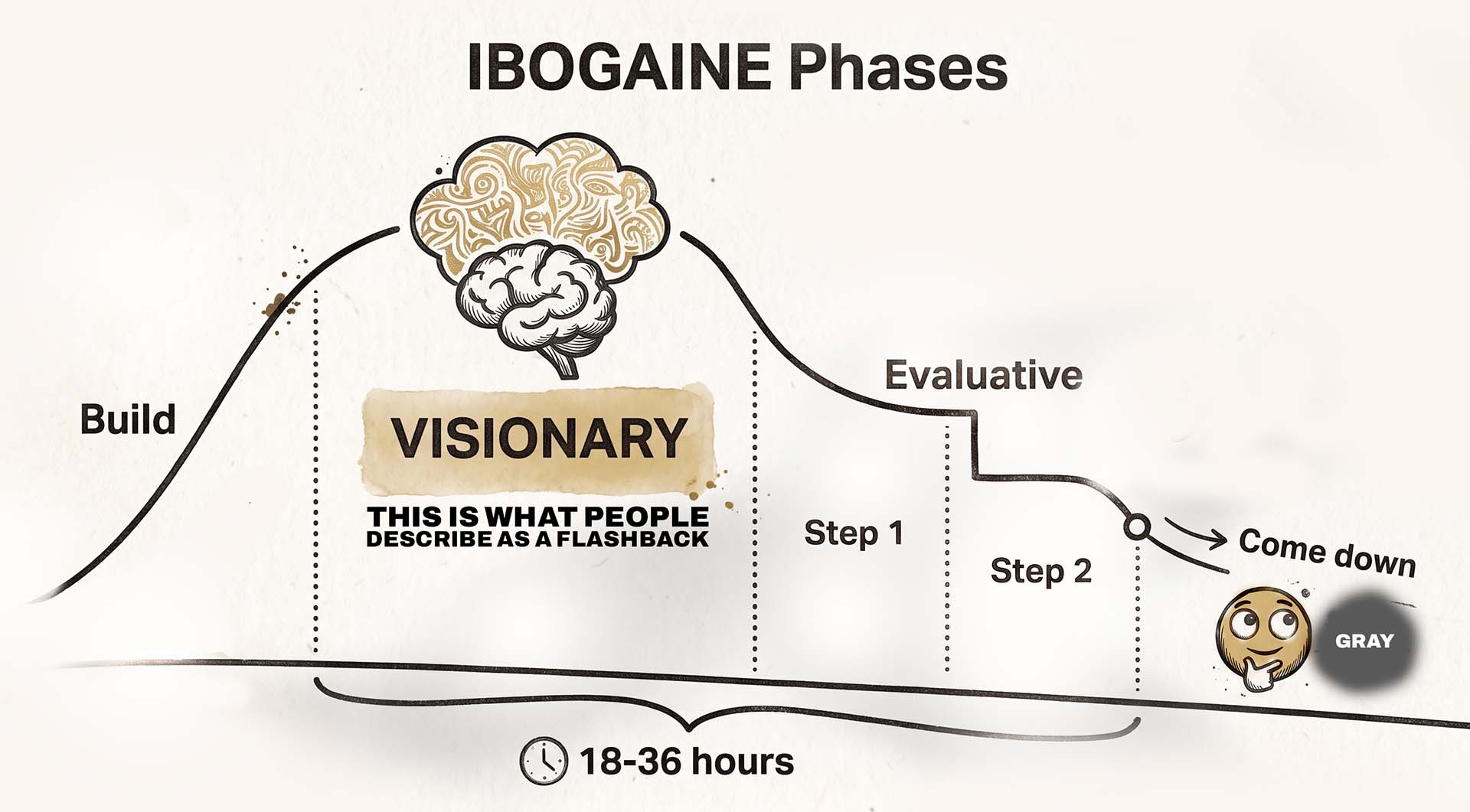
An ibogaine experience typically lasts 18 to 36 hours and moves through phases: a buzzing, heavy onset in the first hours, then a waking-dream visionary phase where scenes from your own life replay with unusual clarity, then a long, sober-feeling introspective stretch where much of the psychological work happens, followed by exhaustion, deep rest, and an afterglow lasting days to weeks.
Physically it is demanding: full loss of coordination, nausea, and measurable cardiac stress, which is why the entire experience happens lying down under medical monitoring.
Most people describe ibogaine as the most intense experience of their life, and most of the same people say they would do it again. Both things are worth taking seriously. What follows is the composite arc from the phenomenology literature, the clinicians we interviewed, and personal experience.1 Doses, settings, and nervous systems differ, so treat the hour markers as a map rather than a schedule.
Hours 0 to 3: the onset
After a test dose and then the full dose, the first unmistakable sign for most people is sound: a buzzing or oscillating tone that grows until it feels like the soundtrack of the experience. Skin goes sensitive, light gets sharp, and coordination starts leaving early, well before the visions arrive. This is ataxia, and it is why reputable providers have you lying down with the lights low before anything begins. Standing up to walk during an ibogaine journey stops being an option surprisingly fast, and trying is how people get hurt.
Nausea usually shows up in this window too. Providers manage it with pre-treatment fasting and positioning, but plenty of people vomit at some point, and it is worth making peace with that in advance.
Hours 3 to 10 or so: the waking dream
The visionary phase is where ibogaine earns its classification as an oneirogen, a dream inducer, rather than a classic psychedelic. With eyes closed, people describe something like being shown a film: scenes from their own life replaying in high detail, often watched from an observer's position rather than relived. Childhood rooms. Conversations decades old. The faces of people they hurt and people who hurt them. This is the famous life review, and people consistently report a quality of emotional honesty to it, as if the usual self-protective editing were switched off.
Two important honesty notes. First, the visions are not always gentle, and for people carrying trauma or addiction they frequently are not; the experience has a reputation for showing you what you have avoided, which is precisely its therapeutic reputation too. Second, a meaningful minority of people get few or no visions at all, and clinicians are emphatic that a quiet journey does not predict a worse outcome. The pharmacological work described in how ibogaine works happens either way.
Hours 10 to 24: the gray evaluation
The cinematic phase fades into something longer and stranger: a flat, clear-eyed, almost sober-feeling stretch that people variously call the evaluative phase, the processing phase, or simply the gray day. Time distorts badly here; hours feel like days. There is nothing entertaining about it, and several clinicians told me this unglamorous stretch is where the real psychological work happens, as the material from the visions gets turned over, examined, and filed differently than it was before.
Expect boredom, expect emotional rawness, and expect to be very awake: ibogaine is stimulating, and sleep typically will not come for 24 hours or more from the start. You remain physically depleted and uncoordinated through all of it, still under monitoring, because the cardiac risk window extends well past the interesting parts (that story is in the safety guide).
The days after: exhaustion, rest, afterglow
When sleep finally arrives it tends to be deep and unusually restorative, and people often wake from it feeling scrubbed clean: rested in a way that surprises them, quieter in the head, with cravings absent or muted and mood lifted. That is the beginning of the afterglow, driven substantially by the long-lasting metabolite noribogaine, and it typically runs days to weeks. It is also the single most valuable and most squandered window in the entire process, which is why the integration guide exists and why I nag everyone about it.
Physically, plan on being wobbly and low-energy for several days, with sensitivity to light and sound tapering off. Emotionally, expect some waves; a temporary dip after the first shine wears off is common and normal, and knowing that in advance keeps it from feeling like failure.
How it compares to other psychedelics
If your reference point is psilocybin or LSD, recalibrate. Ibogaine is far longer, far more physical, and aimed inward at your own biography rather than outward at perception. One guide who has prepared people for both put it in a way I have never improved on: mushrooms invite you to soften and open, while ibogaine asks you to endure. People rarely call an ibogaine journey fun, recreational use is essentially unheard of, and the physical risk profile means it should never be approached casually. What people call it, over and over, is meaningful. Almost universally, and often years later, that is the word that survives.
Key takeaways
- Plan for 18 to 36 hours, then several more days of recovery. This is a marathon, not an evening.
- The phases are consistent: buzzing onset, autobiographical waking dream, long gray evaluation, deep rest, afterglow.
- It is physically demanding: full ataxia, nausea, sleeplessness, and cardiac stress, all of which is why it happens lying down under monitoring.
- No visions does not mean no benefit. A quiet journey is common and does not predict outcomes.
- The afterglow is the point of leverage. The days to weeks after treatment are where lasting change gets built or lost.
Frequently asked questions
How long does an ibogaine trip last?
The acute experience typically runs 18 to 36 hours from dosing, followed by several days of physical recovery and a days-to-weeks afterglow driven by the metabolite noribogaine. Plan for at least three days on site and a gentle week after.
Is the ibogaine experience enjoyable?
Rarely, in the recreational sense. It is long, physically taxing, and emotionally direct, and people describe it as demanding rather than pleasant. The same people overwhelmingly describe it as one of the most meaningful experiences of their lives.
Do you hallucinate with your eyes open on ibogaine?
Mostly no. The visionary content is predominantly a closed-eye, dreamlike experience of autobiographical scenes. Open-eyed perception tends to be altered, with light sensitivity and tracers, but not the immersive visual distortion associated with classic psychedelics.
Can you stop an ibogaine experience once it starts?
No. There is no off switch and no reversal agent, which is one more reason the decision to start belongs in a screened, monitored medical setting. Once dosed, the commitment is the full arc.
Will I be able to sleep during it?
Almost certainly not for the first 24 hours or more; ibogaine is stimulating. Deep, restorative sleep typically arrives after the evaluative phase ends, and it is often described as the best sleep in years.
Sources
- Alper KR. "Ibogaine: a review." The Alkaloids: Chemistry and Biology, 2001;56:1-38.
- Naranjo C. The Healing Journey: New Approaches to Consciousness. Pantheon Books, 1973.
- Heink A, Katsikas S, Lange-Altman T. "Examination of the phenomenology of the ibogaine treatment experience: role of altered states of consciousness and psychedelic experiences." Journal of Psychoactive Drugs, 2017;49(3):201-208.
- Schenberg EE, de Castro Comis MA, Alexandre JFM, et al. "A phenomenological analysis of the subjective experience elicited by ibogaine in the context of a drug dependence treatment." Journal of Psychedelic Studies, 2017;1(2):74-83.